
About BurtuQal
BurtuQal means orange in Arabic.
But the word carries more than a fruit. It carries a journey.
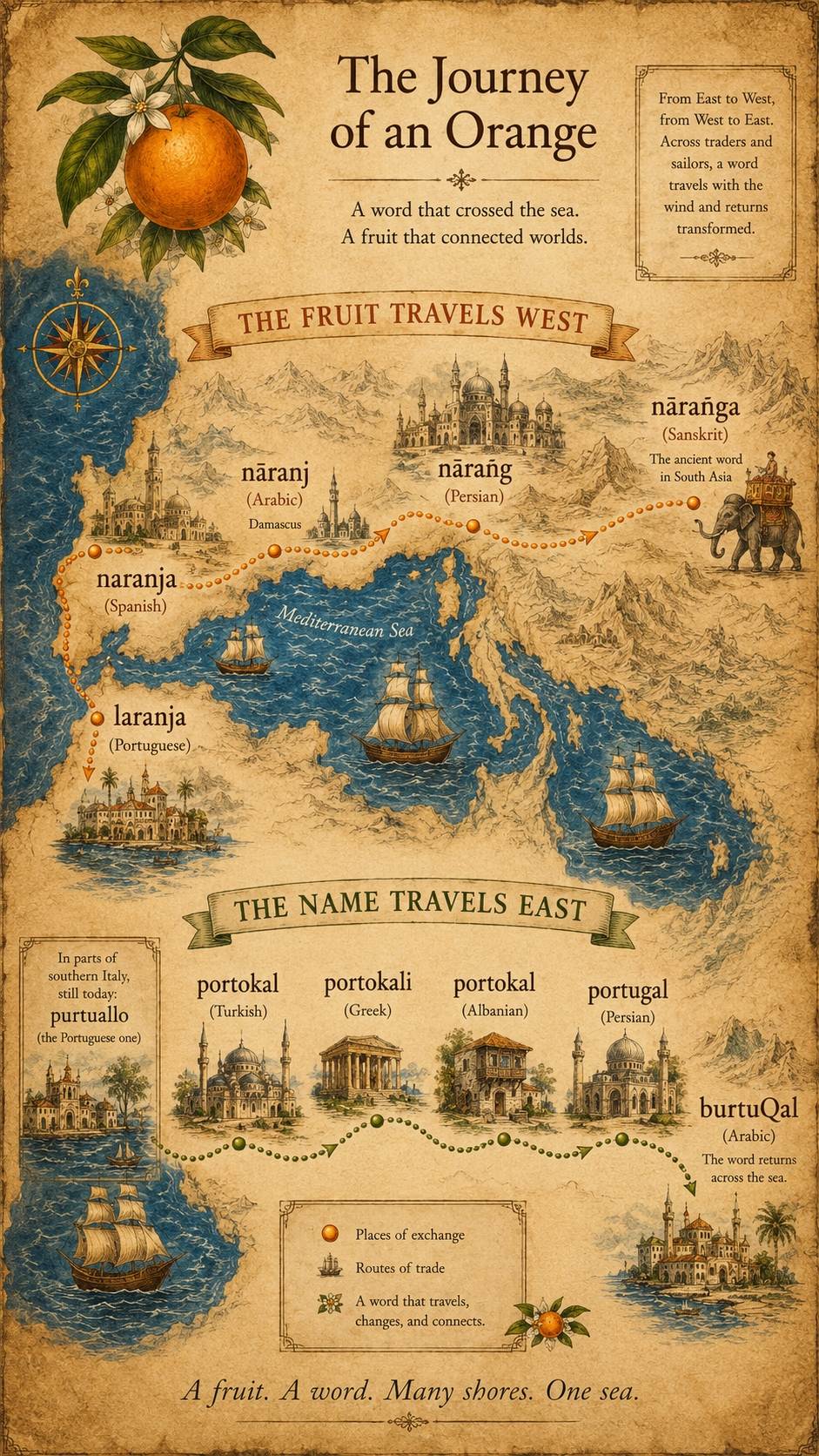
The story begins long before Portugal. The orange travelled from South and Southeast Asia into Sanskrit as nāraṅga, then into Persian as nārang, and Arabic as nāranj. From there, the fruit and its name moved westward across trade routes, gardens, ports, and languages.
In Spanish, the word kept its first sound and became naranja. In Portuguese, it shifted into laranja. In Italian and French, the initial sound disappeared, becoming arancia and orange.
And so, orange was born.
At first, this journey belonged largely to the bitter orange, the nāranj that travelled through Arab and Mediterranean worlds. Later came the sweet orange, brought to Europe through Portuguese trade routes linking Lisbon to India, Asia, and beyond.
That is when the journey turned back.
Later, the sweet orange became closely associated with Portugal. As it spread through Mediterranean trade routes, Portugal's name travelled with it. Variations of the word appeared across Greek, Turkish, Albanian, Bulgarian, Romanian, Persian, Arabic, Georgian, Amharic, and many other languages, each carrying traces of the same journey.
In parts of the Mediterranean and beyond, forms such as portokali, portakal, portokall, portocală, porteghal, and burtuqal still echo that connection.
The older nāranj journey gave Portugal laranja. The later Portuguese journey gave Arabic burtuqal.
This circular journey is the spirit of BurtuQal Culture.
This is not a story of culture as conquest, or identity as territory. It is a story of movement, translation, borrowing, return, and change. BurtuQal takes its name from that more generous idea of culture: something that travels between people, not something that belongs to only one place.
Based in Lisbon, BurtuQal Culture is a platform for artistic encounters shaped by Portugal, the Mediterranean, North Africa, the Arab world, and neighbouring cultures. We create events where music, comedy, storytelling, visual culture, and live performance move between languages, memories, and audiences.
The Mediterranean has never been only a border. It has also been a road. Across centuries, sailors, traders, migrants, artists, and communities carried words, instruments, recipes, rhythms, stories, and beliefs from one shore to another.
Lisbon is a fitting home for this idea. Facing the Atlantic, marked by Mediterranean and Iberian histories, and connected to many routes of movement, the city sits at the edge of several worlds without belonging to only one.
BurtuQal Culture follows that movement.
Not as nostalgia.
Not as a fixed identity.
But as a living exchange.
Like the orange, culture travels. It changes names. It crosses borders. It returns differently.